Showing posts with label Photography. Show all posts

Wednesday, 4 April 2012

Richard Avedon

Buongiorno to all! I am not going to excuse myself for not posting recently and can only assure you that I was not just sitting around twiddling my thumbs - there were genuine reasons why I lacked the time to post.
So... I am happy to say I have reached the hundred follower mark. Whoopee! Yes, that may not seem like a lot but it means a lot to me so thank you and keep following. I promise I will keep posting and this length of absence should not happen again.

I am currently on Holiday, in France, visiting my Grandmother and yesterday I had a marvellous time galloping around 'La Foret de Fontainebleau' with my cousins. Tomorrow, Paris!


Today, I am posting about Richard Avedon, a photographer who, and I really cannot say it better than this quote:

"His fashion and portrait photographs helped define America's image of style, beauty and culture for the last half-century."

Richard Avedon


Born: May 15th 1923, New York
Died: October 1st 2004, Texas

  • Avedon was born in New York City to a Jewish Russian family.
  • After briefly attending Columbia University, he started as a photographer for the Merchant Marines in 1942, taking identification pictures of the crewmen with his Rolleiflex camera given to him by his father as a going-away present.
  • In 1944, he began working as an advertising photographer for a department store, but was quickly discovered by Alexey Brodovitch, the art director for the fashion magazine Harper's Bazaar. Lillian Bassman also promoted Avedon's career at Harper's.
  • In 1946, Avedon had set up his own studio and began providing images for magazines including Vogue and Life. He soon became the chief photographer for Harper's Bazaar.
  • Avedon did not conform to the standard technique of taking fashion photographs, where models stood emotionless and seemingly indifferent to the camera. Instead, Avedon showed models full of emotion, smiling, laughing, and, many times, in action.
  • In 1966, Avedon left Harper's Bazaar to work as a photographer for Vogue magazine. He proceeded to become the lead photographer of Vogue and photographed most of the covers from 1973 until Anna Wintour became editor in chief in late 1988.
  • Notable among his fashion advertisement photograph series are the recurring assignments for Gianni Versace, starting from the spring/summer campaign 1980. He also photographed the Calvin Klein Jeans campaign featuring a fifteen year old Brooke Shields, as well as directing her in the television commercials. 

"When Dick walks into the room, a lot of people are intimidated. But when he works, he's so acutely creative, so sensitive. And he doesn't like it if anyone else is around or speaking. There is a mutual vulnerability, and a moment of fusion when he clicks the shutter. You either get it or you don't". Brooke Shields

  • In addition to his continuing fashion work, Avedon began to branch out and photographed patients of mental hospitals, the Civil Rights Movement in 1963, protesters of the Vietnam War, and later the fall of the Berlin Wall.
  • During this period, Avedon also created two famous sets of portraits of The Beatles. The first, taken in mid to late 1967, became one of the first major rock poster series, and consisted of five striking psychedelic portraits of the group — four heavily solarized individual color portraits and a black-and-white group portrait taken with a Rolleiflex camera. The next year he photographed the much more restrained portraits.
  • Avedon was always interested in how portraiture captures the personality and soul of its subject. As his reputation as a photographer became widely known, he brought in many famous faces to his studio and photographed them with a large-format 8x10 view camera. His portraits are easily distinguished by their minimalist style, where the person is looking squarely in the camera, posed in front of a sheer white background. Avedon would at times evoke reactions from his portrait subjects by guiding them into uncomfortable areas of discussion or asking them psychologically probing questions. Through these means he would produce images revealing aspects of his subject's character and personality that were not typically captured by others.
  • He is also distinguished by his large prints, sometimes measuring over three feet in height. His large-format portrait work of drifters, miners, cowboys and others from the western United States became a best-selling book and traveling exhibit entitled In the American West, and is regarded as an important hallmark in 20th century portrait photography, and by some as Avedon's magnum opus.
  • When first published and exhibited, In the American West was criticized for showing what some considered to be a disparaging view of America. Avedon was also lauded for treating his subjects with the attention and dignity usually reserved for the politically powerful and celebrities.
  • Avedon became the first staff photographer for The New Yorker in 1992. He has won many awards for his photography, including the International Center of Photography Master of Photography Award in 1993, the Prix Nadar in 1994 for his photobook Evidence, and the Royal Photographic Society 150th Anniversary Medal in 2003. He was elected a Fellow of the American Academy of Arts and Sciences in 2001.
  • Avedon had numerous museum exhibitions around the world, including The Metropolitan Museum of Art, the Whitney Museum of Art in New York, the Guggenheim Museum Bilbao in Spain, and the Museum of Fine Arts, Boston.


Richard & Audrey

Hollywood presented a fictional account of his early career in the 1957 musical Funny Face, starring Fred Astaire as the fashion photographer "Dick Avery." Avedon supplied some of the still photographs used in the production, including its most famous single image: an intentionally overexposed close-up of Audrey Hepburn's face in which only her famous features - her eyes, her eyebrows, and her mouth - are visible.
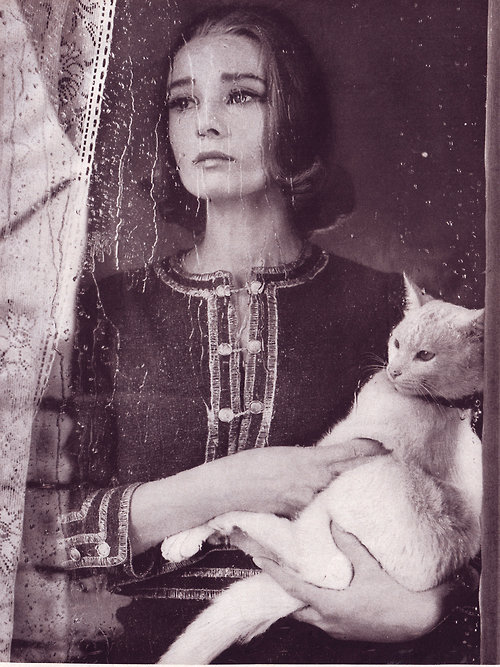


Hepburn was Avedon's muse in the 1950s and 1960s, and he went so far as to say "I am, and forever will be, devastated by the gift of Audrey Hepburn before my camera. I cannot lift her to greater heights. She is already there. I can only record. I cannot interpret her. There is no going further than who she is. She has achieved in herself her ultimate portrait."


Dovima with Elephants


In August 1955, Richard Avedon held an ambitious fashion shoot that was to showcase French fashion designer Christian Dior.

Although most conventional fashion images after the Second World War were shot in the studio, Avedon often created his images outside, posing his models in streets, cafés and casinos.... and the location for this shoot was inside the famous Cirque d'hiver in Paris.

The model in the Cirque d'hiver shoot was Dovima. Her real name was Dorothy Virginia Margaret Juba.
Tall and slender, Dovima epitomised 1950s style and was said to be one of the highest-paid models of the period. 

The shoot took place on a hot summer's day. Avedon later recalled that when he entered the area where the elephants were kept, he saw that the animals were beautifully lit by natural light. 'I saw the elephants under an enormous skylight and in a second I knew… there was the potential here for a kind of dream image.'

In the most famous image from the shoot, Dovima is shown in an ankle-length black evening gown with a white sash. It was the first dress designed for Dior by Yves Saint-Laurent. Although the elephants each had one foot chained to the floor, they were still potentially dangerous and Dovima had to hold her nerve as they moved restlessly behind her. She is shown striking a graceful, narcissistic pose, her eyes almost closed, with one hand resting on an elephant's trunk. In the second picture, she was in a white dress with long black gloves.

The picture has become iconic for a number of reasons. First, its almost surreal juxtaposition of the model and elephants is visually arresting and unexpected, combining fantasy and reality. Second, it is beautifully lit and elegantly posed. Finally, the picture represents a contrast of opposites: youth and age, strength and frailty, grace and awkwardness, freedom and captivity. The picture's rich combination of qualities elevates it beyond the standard fashion image and into the realm of high art.
'Dovima with Elephants' is widely regarded as one of the most iconic fashion photograph of the 20th century. Avedon recognised its importance and displayed a large print of the image in the entrance to his studio for more than 20 years. He nevertheless remained unsatisfied with it. 'I look at that picture to this day and I don't know why I didn't have the sash blowing out to the left, to complete the line of the picture,' he said late in life. 'The picture will always be a failure to me because that sash isn't out there.'


Thank you for reading! Please follow and DO comment! Seriously, I don't bite... well, not all the time. 

Wednesday, 29 February 2012

Sarah Moon


Greetings Folks!  Today is February the 29th - leap year! Technically. according to popular legend, today is the only day in the year on which a woman is allowed to propose to a man... I think, in my case, if I wish to do this, I might leave it another two, three or four leap years. :) When I was a small child at the beginning of primary school, I used to hate February for the odd day number. Aged four, ot was bad enough learning the days in all twelve of the months going, "Thirty days hath September, April, June and November. All the rest have thirty-one save... February..." and then I would go wrong.
Oh, did you know, on this day in History, in 1940, Hattie McDaniel became the first African-America to win an Academy Award for her role as Mammy in 'Gone with the Wind'
Anyway, today I am going to do a brief 'thing' (so to speak) on the photographer, Sarah Moon.

She was born, Marielle Hadengue (since she is of French Origin) in England in 1940.  She studied drawing in an Art School and, by 1960, was a recognised model. In 1966, she switched to being behind the camera. 
Her work was noticed at the Modinsolite Exhibition of Avant-Garde Fashion Photography, Delpire Gallery, in Paris in 1968.  Sarah Moon became known for her impressionistic style -  Her work is noted for a sort of softness, a vagueness that's suggestive of the impressionist painters. Though, apparently this came quite naturally since she, like myself in fact, is short-sighted (myopia) I will not say that this is the only reason for vagueness, but it could easily be contributing. After all, when describing the world with my glasses off, the easiest way I have found to do so is saying that everything simply looks like a Monet, though maybe not that bad.

She photographed for Vogue, Elle, Harper's Bazaar (Great Britain), Marie-Claire and other magazines.

 In 1968, Sarah Moon introduced soft-focus visions or illusions as personifications of new fashions with a turn-of-the-century silhouette (on a side note, a silhouette which I am personally fond of)

Her work generates a sense of mystery.  For example, this photo:
<<< 'Pour Madame Figaro'


There is a certain essence of fancy, luxury and, maybe more to the point, melancholia or simple nostalgia manifested in her pictures.  Another point to her photography was her use of distressed prints to give her photos a feeling of age.
The same fancy and almost melancholia, is also clear in Moon's interpretations of Fairytales. For example, in 1985, she gave a personal interpretation to Little Red Riding Hood by directing adult models in sequences.  Another example is her most recent exhibition which looks at the story of The Little Match Girl.

Since 1980, Moon has made hundreds of photos and adverts for  a diverse range of brands.  She has also done regular fashion campaigns for Cacharel. 
In 1990, she was an honored guest at the Fashion Festival of Budapest (which I need to find out about. I have never actually heard of it, and I like knowing things)
 In 1992, Sarah Moon had a solo exhibition at the Staley-Wise Gallery, in New York.
Oh, and taking a step back down my slightly warped tineline, she also received the International Center of Photography Award for Fashion Photography in New York in 1983.
<<< I love this photo. It is a lot more modern than it looks and I really like the use of distressed print to create this charming effect. It looks like a photo taken in the 1920s. Though, on the other hand, it does have a feeling of timelessness to it. I adore the hat, and think the expression on the model's half-concealed face is beautiful in capturing the feeling of the picture. The pearl earring also draws a perfect amount of light into the picture as well.


"I believe that if I didn't work in commercial photography, I would never work in colour. I don't really like colour. To make it work for me, I have to mess with it." Sarah Moon


 "What I aim at is an image with a minimum of information and markers, that has no reference to a given time or place, but that nevertheless speaks to me, that evokes something which happened just before or may happen just after."


On a last note, in honour of Davy Jones who died this morning of a heart attack, aged sixty-six, I am going to include a song by 'The Monkees' in this post (Though I honestly only know two Monkees songs) I hope you enjoy.


Thank you for reading. Please comment and do follow!

Sunday, 19 February 2012

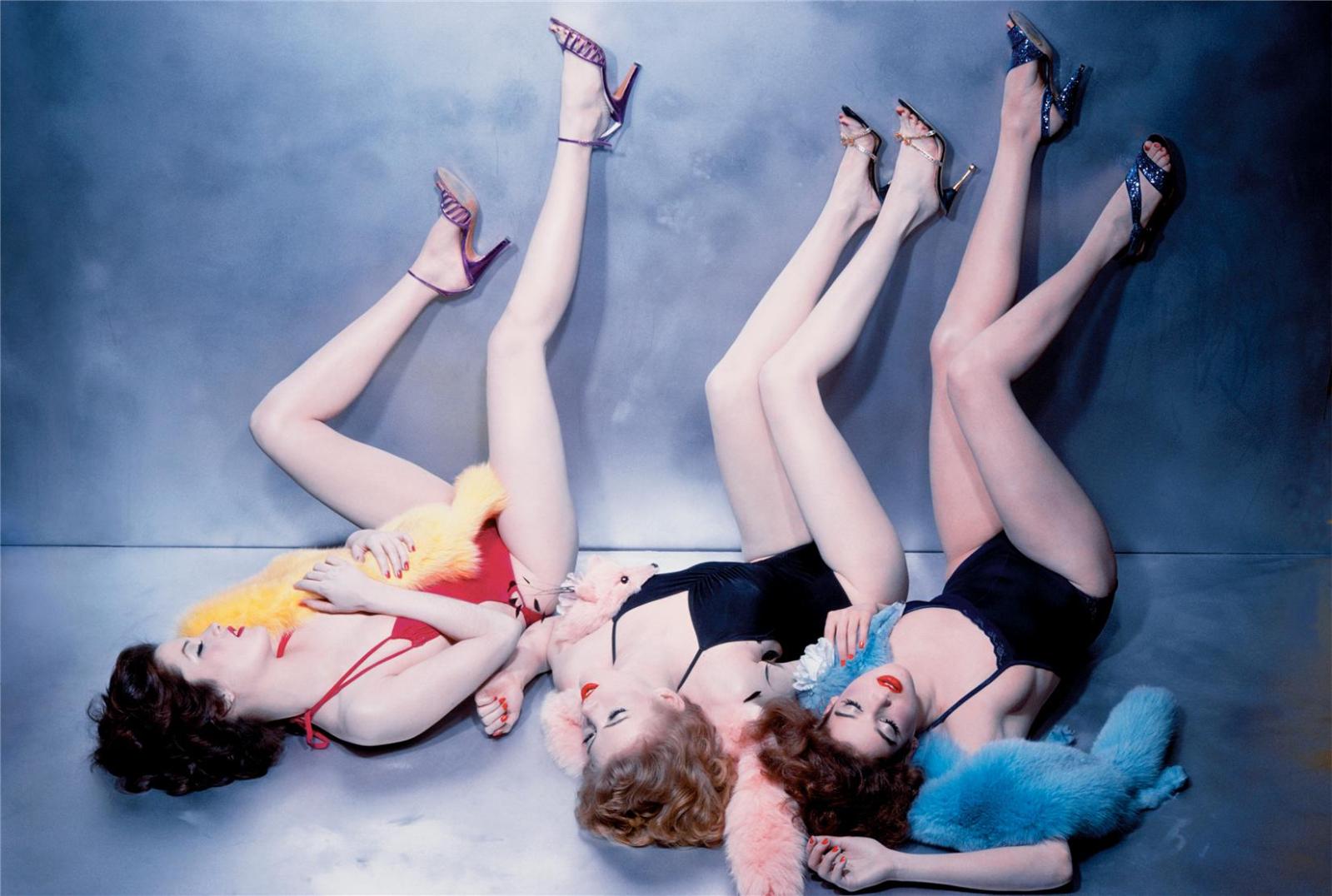
The Genius of Guy Bourdin


Salutations! Having spent a week doing too little revision for too long and watching Capra films, I realised with a jolt that I had not posted since last Monday and, since I did not wish to do the whole Monday-Monday (whoops! I have not posted for a week) thing, I felt I should post this sooner than I otherwise intended to. Anyway, the caffeine and bruise on my head is keeping me awake so I came to the conclusion that posting would be a more valuable use of my time than surfing BBC iPlayer or Youtube in order to find a random video or programme that I would be happy to watch until I felt ready to curl up into a ball and sleep.
I am here to present those of you who do not know to Guy Bourdin. Photographer - one of the greatest fashion photographer's of all time.

Guy Bourdin was born in Paris on the 2nd December 1928. When his parents separated, and his mother left approximately a year after giving birth to him, he went to live in Normandy with his paternal grandparents who owned a brasserie. When his Father remarried, he moved back in with his father, stepmother and stepsiblings. By all accounts, he only met his mother once and his only abiding memory was of a sophisticated parisian woman, with pale skin and red hair, an image that was recurring in many of his photos. Abandonment became a personal and professional motif. At the age of eighteen he went on a tour of Provence and met Lucien Henry, an art dealer. He stayed with Lucien for six months where he seriously applied himself to drawing and painting and initially decided to become an artist. When it was time for his military service he ended up in Dakar as an aerial photographer in the Air Force.
After his military service he returned to Paris. He still drew and painted and started taking pictures for himself. He was influenced by Surrealism and of all the Surrealists. His greatest influence was Man Ray (a notable work is the Violon d'Ingres) with whom he became friends. Man Ray  even wrote the catalogue text to Bourdin's first exhibition in 1952.
It was two years later that, at the age of twenty-seven, he was offered a job at French Vogue. His debut was four pages of hats. One of the pictures featured a woman standing below three skinned calves' heads. It was a statement that marked out the direction of his style as a photographer.


He was best known for his work for French Vogue from the mid fifties to the mid eighties.... and it was typically dark, theatrical and even disturbing. In fact, I'm going to set this straight, to a relatively innocent 1970s audience, some of it was perversely shocking (for general appearance in a Fashion Magazine) and much of it was macabre. Guy Bourdin's advertisement for Charles Jourdan shoes showed the chalked outline of a woman on an apparently blood spattered pavement, her gorgeous red shoes and red sunglasses abandoned near where her body had fallen. A lot of the darker pictures that Bourdin did take were never even published. One such unpublished photograph, taken in 1978, showed a naked woman draped across a desk, her throat cut, surrounded by blood. So yes, there is something more than a little strange about his obsession with death and desire. People have called him a misogynistic puppet master, which is perfectly fair considering - Guy Bourdin was a short man with an apparently whiny voice, and had a reputation of being incredibly demanding. Dark rumours (which were not really rumours, more unpleasant truths) surrounded him: his mother abandoning him as an infant, the suicides of his wife and two of his girlfriends, and the cruelty in which he treated his models.


Whatever can be said about Guy as a person, (and obviously, a lot of controversial things could easily be said) his photos are incredibly striking and incredibly recognisable. He shattered taboos (though I think the made-up ten year old is still something rather disturbing to anybody)
In many ways he was like Warhol and Hitchcock, using photography in a more psychological way and using the personal understanding of an outsider looking in.

He died of Cancer in 1991.


His son Samuel Bourdin released a book with the finest prints of his father's work, called "Exhibit A" in 2001. His first retrospective exhibition was held at the Victoria & Albert Museum in London 2003, and then toured the National gallery of Victoria in Melbourne, and Jeu de Paume in Paris.

In 2003, Madonna's music video for Hollywood (which I have posted here, purely for the purpose of illustrating my point than any great love of this song) was greatly influenced by the photography of Bourdin, so much so that a lawsuit was brought on against her by Bourdin's son for copyright infringement.


Anyway, thank you for reading - if you did indeed read, and did not simply glance up and down the pictures. Please comment and feel free to follow (Really. Do so.)
I should be back with something lighter next time because, after a post in which I listed forms of human sacrifice then this one, in which I discussed someone who very much thought of himself as 'un poete damne' whose emotional pain was self-inflicted, I think something lighter would clear the air.

Ciao.

Friday, 20 January 2012

Let's Dance!

Greetings, and welcome to my exploration of Dance in the world of fashion - using two beautiful Vogue editorials, and a few extra tidbits.
It feels like a while since I posted - but the irregularity is only going to get worse. Sunday, you shall have another!

Anywho, does anyone who reads Vogue (the british one) remember this editorial from August 2011? I remember it as one I actually really liked... not only because of the beautiful clothes, but because of what I considered to be a great concept. Arizona Muse modelled every outfit - coincidentally, she is on the cover of February 2012 Vogue, and looked more than usually gorgeous in certain costumes.


Maybe what I loved the most about this editorial, and why I flicked to look through it a number of times, was the wonderful variety alongside the beautiful assemblement of everything as a whole. From couples dancing Fun Jives, elegant Foxtrots and sizzling tangoes... to 70s-style Divas. Not, of course forgetting, Arizona Muse in a beautiful ballet-inspired costume while real-life ballerinas on either side of her strike impressive poses.
 Also not forgetting, bien sur, Jean Paul Gaultier's fantastic semi-can can, semi-burlesque (which in terms of outfits, is hard for people like me - who honestly don't really see much can can or burlesque - to judge which of the two it is. I would lean towards something more burlesque)


Of course, I would state that Fashion has always greatly influenced the ballet - and vice versa. In 1924, Coco Chanel designed the costumes for 'Le Train Bleu' (probably a ballet less known in popular culture, but inspired by Agatha Christie's 'The Mystery of the Blue Train', with a story by the brilliant Jean Cocteau and a curtain painted by the legendary artist Pablo Picasso which, on top of the Coco Chanel having designed the costumes issue,  would make this Ballet something I would kill to have seen the original of... and I am certain I am not the only one.)


Anyway, so if this editorial showed a delightful fantasy of dance and ballet, the following one was quite different. Although it had the same title, it was a lot more bitingly realistic, in both clothing and with drastic photography.

See what you think - Sasha Pivovarova transformed into a dancer, for Vogue Paris , December 2011.


 So, which do you prefer? To a certain extent, a Biting Realism or a more lyrical fantasy I think the two sets of photos show two different sides to the same world of dance and of music. Backstage vs. the glittering lights. The costumes, the glamour and the elegance vs. the hard work, training and physical strain?

I would write more, but am severely exhausted. I will simply serenade you out with a little David Bowie. Not because it has anything terribly to do with either of the editorials, but because I love Bowie's music and the title is the same Let's Dance!


I hope you enjoyed reading this. Please comment (for example, which editorial do you prefer?) Do follow if you like.

Thursday, 8 December 2011

Javier Vallhonrat

Salutations! So... today I was intending to do a piece on items of my wardrobe, but I had miscalculated our gloomy english weater (and my eventual lack of common sense) forgetting that on the eighth of december, by half past four, the light will probably not be good enough to take any worthwhile photos. In fact, barely an hour later, and the light is not good enough to see my hand in front of my face if I am standing outside and away from the glare coming from the windows of the house.
In conclusion, I shall reserve that post for Saturday and, instead, give you an aesthetic delight. Breath-taking photographs taken by Javier Vallhonrat. Although I do admit, I initially wished to have a balanced range from his photographic portfolio, I have ended up with a larger percentage of photoshoots from the noughties than from any other time.
Anyway, I hope you enjoy... and do comment - I greatly appreciate all comments. Even if they are negative.


 Javier Vallhonrat in a Spanish Photographer, born in Madrid in 1953. He studied Painting at the Fine Arts Faculty of the University of Madrid in the early 70’s. Just after receiving a degree in Fine Arts at the University of Madrid, he reached international recognition while contributing his photos to several fashion designers. In 1992 he broadened his interest in photography and began creating advertising films, while on the side teaching photography at the Cuenca School of Fine Arts.

Today, while continuing his contribution of photos for French Vogue, Italian Vogue, Japanese Vogue, Mixte, Big, among others, Javier also teaches creative photography in various universities in Spain. 
Since 1983, Javier Vallhonrat exhibited around the world: Spain, France, Finland, Japan, Vénézula and so on:  1983, EFTA Gallery, Madrid
1986, Galería Visor, Valencia (Spain)
Porin Taidemuseo, Porin, Finland
 1989, Montmajour Abbey, Arles, 1989
1990, Parco Photographers Gallery, Tokyo
1991, 2000, 2001, LA Galerie, Frankfurt am Main
1996, Reina Sofía Museum, Madrid
Museo Santa Monica, Barcelona
 1983, 1994, 1995, 1996, 1999, 2001, 2003, ARCO, Madrid,
2002, Galerie Emmanuel Perrotin, Paris, 2002
2003, National Centre of Photography, Paris
2006, Centre Pompidou, Paris


His use of colour and light is perhaps the most striking thing, and easily recognisable as his range of work. He captures sensuality in a rare and exquisite way, and uses the environment the model is in 'd'une merveilleuse facon', creating a timeless look. He clearly has a great eye for composition, and balance of colours, especially in (what I would class as) pastel colours and warm berry colours. Personally, I love most of his photos. I love his palette, and I think there is a real elegance to his photos. It is much to be admired.
ADVERTISING CAMPAIGNS:
Ayura (cosmetics). Azzaro (parfum). Cacharel (parfum/cosmetics). Carte Noire. Cerruti 1881 (parfum). Chloe. Chopard Parfums. Christian Lacroix (fashion and parfum). Comme des Garcons. Eau Future (parfum). Garnier (hair). Gianfranco Ferre (parfum). Guerlain (parfums). Jesus del Pozo (parfum). Jil Sander. John Galliano (fashion). Krizia. Lancome Beaute. Lancome Parfums. Martine Sitbon. Moet et Chandon. Nichole Farhi. Nicole Matsuda (fashion). Patrizia Pepe. Rochas (parfum). Shiseido. Swarovski. Sybilla. Pollini. Versace (fashion).

His works are in various public art collections and private, has also published several books:          
  Animal Plant and Buades Editor April, Madrid, 1986
  Possessed Space, Gina Kehayoff, Munich, 1992
Autogramas, Gina Kehayoff, Munich, 1993
Banks, Editorial Mestizo, Murcia, 1996, Photographic Works, 1991-1996, Editorial Lunwerg, Madrid, 1997
Library Collection photographer from Madrid, Nr.10, PHotoBolsillo, Madrid, 1999
Javier Vallhonrat: photography as a reflection, TF editors, Alcobendas, 1999
Works 1996-2001, Hall Amos Salvador. Cultural Rioja. T.S. Publishers, 2001 Logroño
Place, City of Tarragona, 2002,
Javier Santiago speaks Vallhonrat Olmo, Ed La Fabrica, Madrid, 2003
ETH, Salamanca Arts Centre, 2003,


 COMMERCIAL FILMS:Rochas (parfum). Hypnose (Lancome). Yves Saint Laurent (make-up). Cacharel (Eden parfum). Gianfranco Ferre (parfum). Eau Future (parfum). Fructis (hair). Gaz de France. L Oreal (hair).